Why do some motorways have such wide central reservations?
Occasionally, curious road users spot something puzzling and want to know what's going on.
Questions about motorways that come up surprisingly often include 'do their numbers mean anything' (they sort-of do), 'what do the signs with numbers mean' and 'is that an unfinished exit'. Another question people like to ask is: why is that central reservation so wide?
A motorway with an unusually wide central reservation can be the sign of an unfulfilled plan. First though, we have to look at the more simple explanations.
Not as exciting as it looks: most wide central reservations are simply to make it easier to see around the bend. Until recently, this would have been grass. Image © Google.

Sharp bends
When somebody asks about a seemingly unnecessarily wide central reservation, most often, they will be pointing to a sharp bend.
High-speed roads have to maintain a decent view of the road ahead, known as the safe stopping distance. If the road bends sharply to the right, that view ahead could be blocked by the barrier and the oncoming traffic. These problems can be easily avoided by making the central reservation wider, and that's exactly what they do, all over the country.
For the same reason of maintaning a clear view, any grass must be kept short. This can be difficult when you're working with Britain's extremely busy and badly-driven road network. As a result, the current preference is to save the effort by taking all the grass out the central reservation. On a very sharp bend with a wider central reservation, this wide tarmac area can look strange (and not to mention ugly and biodiversity-unfriendly), which is why many people wrongly suspect that space is being deliberately left for something more exciting.
Steep hills
This is similar, but slightly different.
If the road is running along the edge of a steep hill, you won't be able to have both sides at the same level. Doing this would involve either creating a very big cutting on one side, or building a large embankment on the other side; both much uglier and more expensive than just running the two carriageways at different heights.
Depending on the exact topography, this can mean making the central reservation wider than usual (as per the M6 in Cumbria), or narrower than usual (as per the M5 in Somerset, which is basically a cliff). Snowfall should also be considered in some areas.
Geology
There are some places where the land can't hold both sides of the motorway (and the traffic bouncing across the top of it) side-by-side. The most famous example of this is the house in the middle of the M62.
Old alignments
This isn't so common on motorways, but it is interesting.
When an existing road is upgraded, a common tactic is to convert the existing road into one half of the new road. The second half of the new road will be built to the current standards, but the old half of the road will generally stick to its old alignment, which could be hundreds of years old. This means there will be places where the old and the new take different routes.
An example of this is where the M40 crosses the River Avon near Warwick. Here, the bridge which carries the southbound carriageway was built in the 1960s to carry both sides of the A41 Warwick Bypass. When the motorway was built in the 1990s, the existing bridge was re-used for the southbound carriageway, with a new bridge on a better alignment provided for the northbound carriageway. This is why the two carriageways aren't parallel.
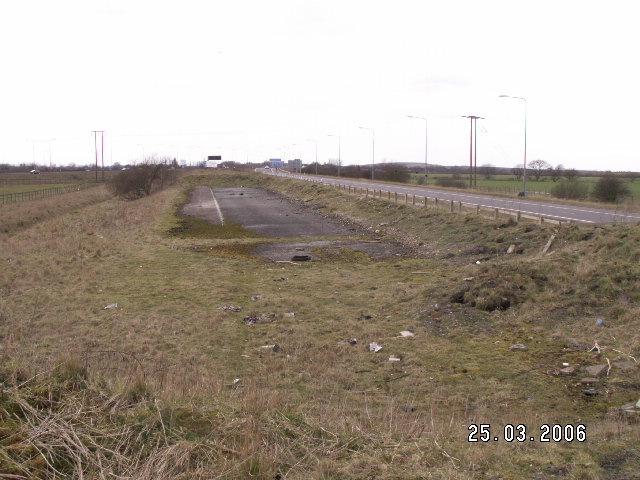
An example where one half of a motorway was abandoned, but the other half still has to go around it.
Future widening
Some roads are built from the start with space to make them wider. Most of the examples on motorways would no longer make sense as they have already been used, but some sources claim that M5 J20-21 was built with space for it to be widened to four lanes.
Northern Ireland's M2 has hard shoulders along the central reservation, which is a similar idea that stemmed from safety fears when wide roads were being built. It was trialled in England but the space was soon needed for widening.
Unfulfilled plans
This is the answer a lot of people are hoping for. A large gap in the middle of a motorway can be a sign that another road was meant to emerge from the centre. These relate to the original construction and will almost-certainly never be used now. Examples of these include:
- M1 J1: space was left for the M1 to be continued to Kilburn
- M8 J20: there are unfinished roads all over Glasgow, but probably the most famous is the ski jumps at J20
- M11 J4: space was left for the M11 to be continued to Hackney
- M23 J7: space was left for the M23 to be continued to Streatham
- M25 J5: while this gap is just what was necessary to create a road layout that kept the motorway away from Chevening, it is true that it was designed on the basis that the M25 would head east from here, and that the A21 would continue north
- M25 J23: the M25 was originally intended to pass south of Watford. The finished line of road was supposed to be the slip roads that would have taken you from the completed road to South Mimms. Fascinatingly, Roads.org.uk reveals that by the time work on this section started, it was already known that this layout would never be needed, but it would have been too difficult to go back and design something less wasteful
- M53 J5: the M53 was originally intended to head south towards Chester. The road which branches off, which is clearly much narrower, was originally allocated the number M531
- M57 J7: space was left for it to continue towards Crosby
- M58 J1: space was left for it to meet the extended M57
- M58 J6: space was left for it to continue towards Wigan
- M60 J25: space was left for the A6(M) to join
- M65 J1A: space was left for it to continue south of Preston
- M67 J1: space was left for it to continue into Manchester
- M67 J4: some space was left for it to continue to Sheffield
- M69 J3: space was left for a pair of decent flyovers onto the M1 north
- A627(M): space was left for a flyover over the M62 roundabout
- A823(M) J1: space was left for it to continue around Rosyth
- A823(M) J2: space was left for it to continue around Dalgety Bay
- M2/M22: the M2 to Ballymena was meant to land in the middle of the point where Northern Ireland's M2 becomes M22, instead of the existing roundabout at M22 J1